Routes
Designing a China Route by Region
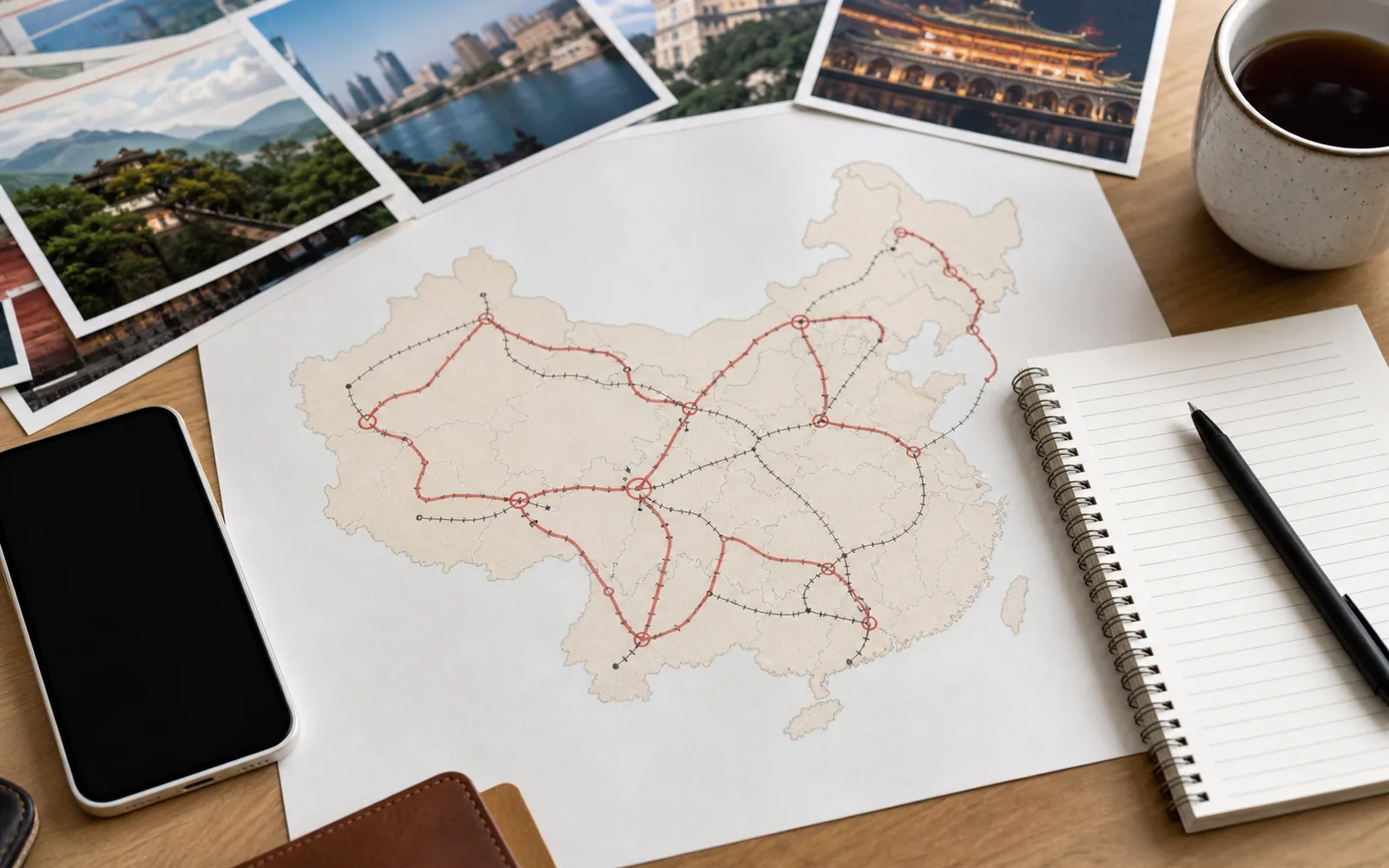
China is easier to understand as regions and route loops, not a single checklist of cities.
Quick answer
Choose one region for depth, or two connected regions for contrast. Avoid stitching together distant highlights without recovery days.
Regions create coherence
A China trip becomes easier when cities belong to a route logic. East China can combine Shanghai, Hangzhou, Suzhou, and Nanjing. North China can combine Beijing, Tianjin, and historical routes. South China can combine Guangzhou, Shenzhen, and border planning. West China can combine Chengdu, Chongqing, and Yunnan gateways.
Regional thinking reduces wasted movement.
Contrast should be intentional
A route can include contrast: Beijing plus Shanghai, Guangzhou plus Chengdu, Shanghai plus Xi'an. But each contrast adds transport and adaptation cost. Good contrast teaches something; random contrast just tires you.
Ask what each region adds to the story of the trip.
Season changes region value
Harbin is highly seasonal. Yunnan can be useful for mild weather. South China can be humid. North China can be cold and dry. Route planning should account for season, holidays, and crowd pressure.
The same region can be brilliant or difficult depending on timing.
Plan gateway cities
A gateway city is where you enter, recover, and connect. Shanghai, Beijing, Guangzhou, Shenzhen, Chengdu, and Xi'an often work as gateways. A gateway should have reliable hotels, transport, food, and onward connections.
The gateway is the hinge of the route.
Practical checklist
- Pick a primary region.
- Choose gateway city by arrival and onward links.
- Limit long jumps.
- Check seasonal fit.
- Use city pairs for contrast.