Transport
Train or Flight in China: A Decision Framework
High-speed rail is not always better than flying, and flights are not always faster. The right choice depends on station access, airport distance, luggage, delays, and arrival time.
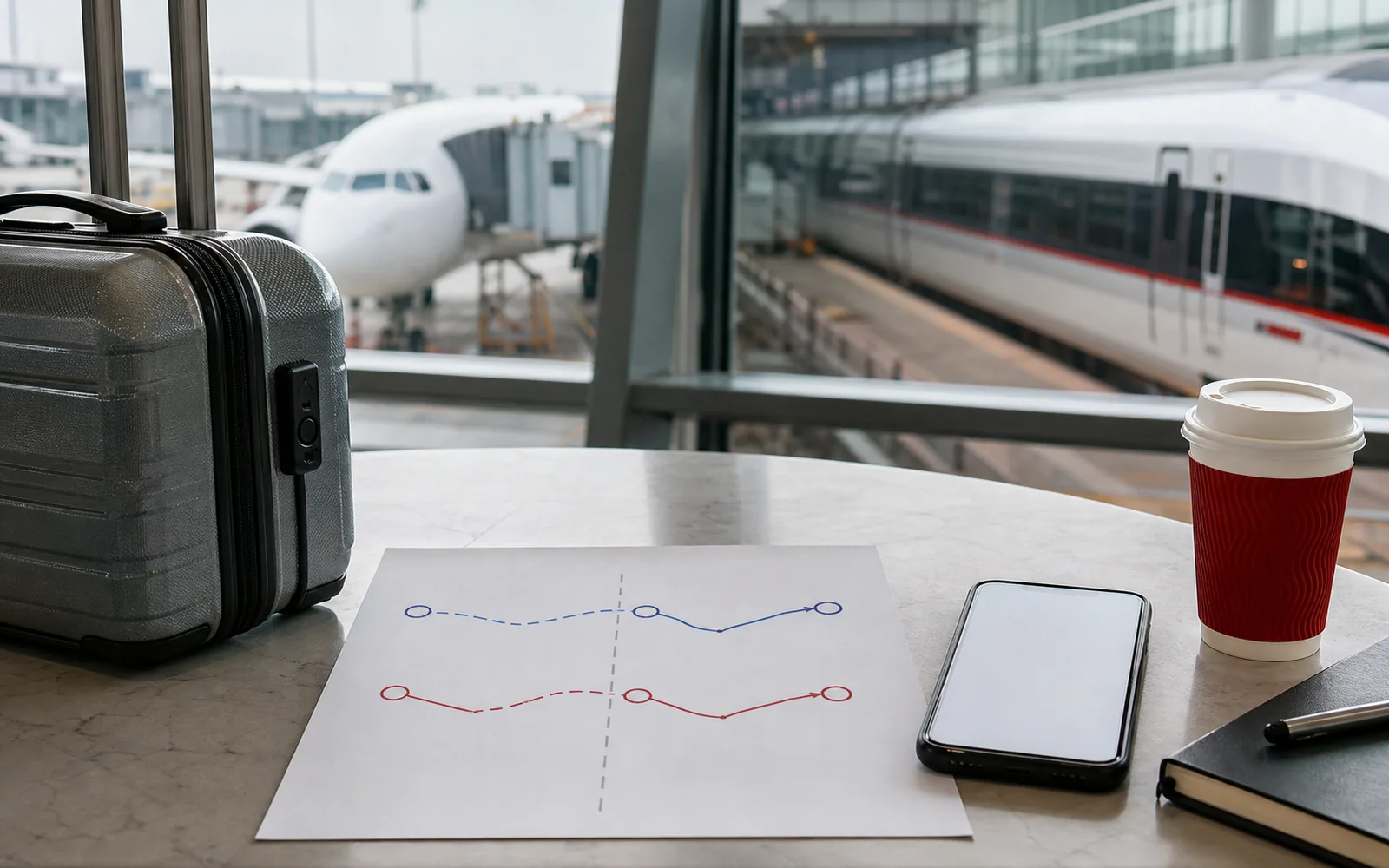
Train-or-flight answer
Compare door-to-door time, not timetable time.
The timetable is not the trip
A two-hour flight can become a six-hour door-to-door process. A five-hour train can be calmer if stations are central and boarding is predictable. China has both excellent rail and extensive domestic flights, so the best choice depends on the whole transfer chain.
Always compare hotel door to hotel door.
Rail wins on city pairs
High-speed rail often works well between cities with strong station access: Shanghai-Hangzhou, Beijing-Tianjin, Guangzhou-Shenzhen, Nanjing-Suzhou, Chengdu-Chongqing, and many east-coast routes. Rail also avoids airport weather delays and can be better for travelers who dislike security-heavy flight days.
Rail is strongest when the stations fit the city plan.
Flights win on distance and geography
Longer routes, western routes, northeast winter routes, and time-limited business trips may favor flights. But airport choice still matters. A late arrival at a distant airport can turn a good fare into an exhausting transfer.
Flights need arrival planning, not just booking.
Luggage and stress matter
Families, older travelers, heavy luggage, or business samples may prefer the mode with fewer transfers and clearer handling. A traveler with one backpack may handle station stairs easily. A traveler with two suitcases may not.
The best transport choice is personal.
Compare door to door, not station to airport
The best choice between train and flight in China depends on the whole day. High-speed rail is often better for city-center to city-center routes such as Shanghai to Nanjing, Beijing to Tianjin, Guangzhou to Shenzhen, or Chengdu to Chongqing. Flights become more attractive when the distance is long, the rail route is indirect, or the airport is close to both ends. The mistake is comparing only ride time. A ninety-minute flight can become half a day after airport transfer, security, delays, baggage and hotel arrival.
Train stations also vary. Some are central and easy; others sit far from the old city or require a long metro ride. Airports have the same issue. Before booking, check the exact station name, not just the city. Beijing South, Beijing West and Beijing Capital Airport are different plans. Shanghai Hongqiao is a useful rail-air hub; Shanghai Pudong is often better for international flights but farther for some city-center stays.
Decision rules that usually work
For trips under about five hours by high-speed rail, train often wins for first-time visitors because boarding is predictable and luggage stays with you. For routes above seven or eight hours, flights often deserve a look, especially if there is a nonstop option. Between those ranges, choose based on departure time, station location, weather season, luggage, and whether a missed connection would damage the next day.
Pair this article with the first high-speed rail guide, train station survival, domestic flights, and the rail planner. A good transport choice is the one that protects the next activity, not the one with the shortest headline duration.
A realistic transport choice
Shanghai to Nanjing is usually a rail decision: the stations are frequent, the ride is short, and airport overhead would be absurd. Shanghai to Kunming is different: a flight may protect the itinerary because the rail day is long. Beijing to Xi'an sits in the middle, so the better answer depends on where you sleep, how much luggage you carry, and whether the next morning has a high-value activity.
When uncertain, compare the moment you leave the hotel with the moment you enter the next hotel room. Add food, station size, baggage and delay risk. That door-to-door comparison is much closer to how the day will actually feel.
Save before choosing rail or air
Before buying, compare exact station or airport names, city transfer time, baggage rules, arrival time and the next day's first commitment. If rail arrives downtown and the hotel is nearby, the train may be calmer. If the route crosses half the country and a nonstop flight lands earlier, air may be the smarter choice. The best option is the one that leaves you functional after arrival.
Compare the day, not the vehicle
The train-versus-flight choice should compare the whole day. Rail may win when stations are central, weather is uncertain, security is simpler, and luggage is manageable. Flights may win when distances are large, the airport is convenient, or the rail route forces awkward transfers. A two-hour flight is not really two hours if the airport sits far from both useful addresses.
Write both options door to door: leave hotel, reach station or airport, security, waiting, ride or flight, exit, reach next hotel, eat, and recover. Then ask which version leaves enough energy for the next day. The fastest timetable is not always the best travel decision. The best option is the one with fewer fragile handoffs.
Door-to-door checks
- Compare door-to-door time.
- Check station and airport location.
- Include security and passport checks.
- Consider luggage weight.
- Avoid late-night arrivals in unfamiliar cities when possible.