Routes
Designing a China Route by Region
China is easier to understand as regions and route loops, not a single checklist of cities.
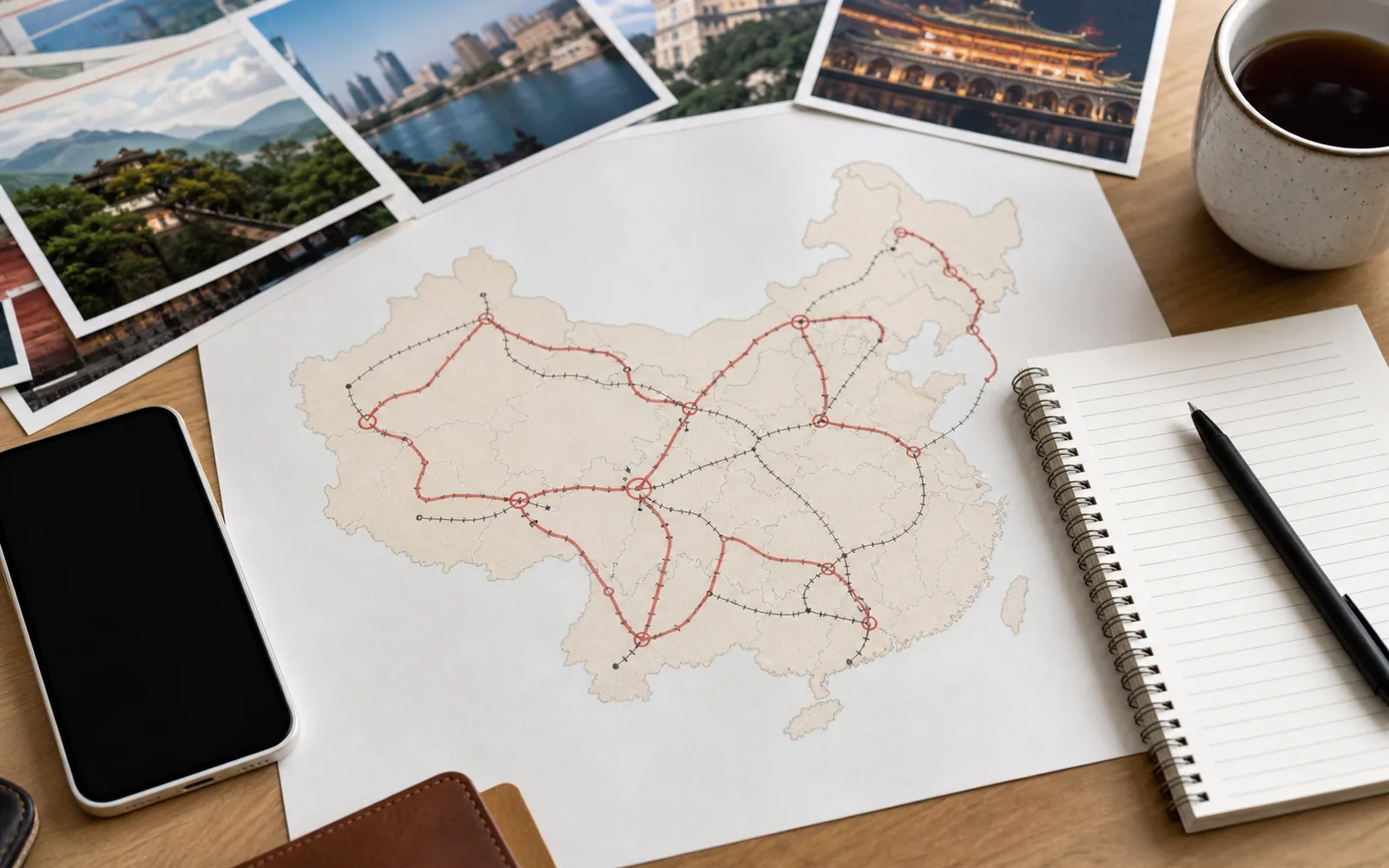
Regional route answer
Choose one region for depth, or two connected regions for contrast. Avoid stitching together distant highlights without recovery days.
Regions create coherence
A China trip becomes easier when cities belong to a route logic. East China can combine Shanghai, Hangzhou, Suzhou, and Nanjing. North China can combine Beijing, Tianjin, and historical routes. South China can combine Guangzhou, Shenzhen, and border planning. West China can combine Chengdu, Chongqing, and Yunnan gateways.
Regional thinking reduces wasted movement.
Contrast should be intentional
A route can include contrast: Beijing plus Shanghai, Guangzhou plus Chengdu, Shanghai plus Xi'an. But each contrast adds transport and adaptation cost. Good contrast teaches something; random contrast just tires you.
Ask what each region adds to the story of the trip.
Season changes region value
Harbin is highly seasonal. Yunnan can be useful for mild weather. South China can be humid. North China can be cold and dry. Route planning should account for season, holidays, and crowd pressure.
The same region can be brilliant or difficult depending on timing.
Plan gateway cities
A gateway city is where you enter, recover, and connect. Shanghai, Beijing, Guangzhou, Shenzhen, Chengdu, and Xi'an often work as gateways. A gateway should have reliable hotels, transport, food, and onward connections.
The gateway is the hinge of the route.
Build routes around transport rhythm, not map distance
China looks compact on a screen until station transfers, airport edges and hotel moves are added. A good regional route starts with the daily rhythm: how many mornings can begin early, how many nights can end late, and how often you are willing to move luggage. East China is forgiving because Shanghai, Hangzhou, Suzhou and Nanjing connect well by rail. Southwest routes are richer but slower because Chengdu, Chongqing, Guilin and Yunnan involve more terrain, airport decisions and weather buffer.
The common mistake is mixing regions too aggressively. Beijing plus Xi'an can work because high-speed rail and flights are straightforward. Shanghai plus Guilin plus Harbin in one short trip may look exciting but creates climate, distance and recovery friction. A route should feel like a chain of strong days, not a collection of famous names.
A practical route test
Before booking, test each move with three questions. Will the transfer still work if the train is later than expected? Is the arrival station or airport close enough to the hotel for the time of day? Does the next morning require energy that the travel day will remove? If two answers are weak, add a night or remove a city.
For a first trip, choose one anchor region and one contrast stop. East China plus Beijing, Beijing plus Xi'an, or Chengdu plus Chongqing are easier than trying to sample the whole country. Use regions, East China, South China, and first-trip itinerary planning to turn the route into transport days rather than just pins on a map.
A realistic route comparison
A first-time traveler may compare Shanghai, Hangzhou, Guilin and Beijing and think four cities in nine days is efficient. On paper it covers icons. In practice it creates repeated packing, station transfers, climate changes and very little recovery time. A stronger version might use Shanghai as the entry base, add Suzhou or Hangzhou by rail, then fly or train to Beijing with one protected travel day.
The improved route may look less ambitious, but it gives each region a purpose. East China handles soft landing and water-town or garden contrast. Beijing handles history and national-scale sights. The reader experiences China more clearly because the route has rhythm instead of constant relocation.
Save before booking a region jump
Before connecting two regions, save the exact departure station or airport, arrival station or airport, hotel transfer time, and the next morning's first activity. If the next day begins early, avoid late arrivals or station changes that depend on perfect timing. A regional route should protect the first morning in each new place. Otherwise the trip pays twice for one transport mistake.
Use friction, not distance, to choose a region
Two cities can look close on a map and still belong to different travel rhythms. The useful regional question is not only distance; it is how many station changes, hotel moves, climate shifts, payment tests, and language moments the route creates. East China can absorb short rail hops because the city pairs are frequent. Parts of the west need more margin because altitude, airport timing, and long transfers make every move heavier.
A stronger route starts with one base that teaches you the local systems, then adds one controlled extension. If the first base is Shanghai, add Suzhou or Hangzhou before attempting a larger loop. If the first base is Chengdu, decide whether the trip is about Sichuan depth or a jump toward Chongqing, Yunnan, or Tibet-edge logistics. Regional design is the discipline of saying no before the map gets crowded.
Route-shape checks
- Pick a primary region.
- Choose gateway city by arrival and onward links.
- Limit long jumps.
- Check seasonal fit.
- Use city pairs for contrast.