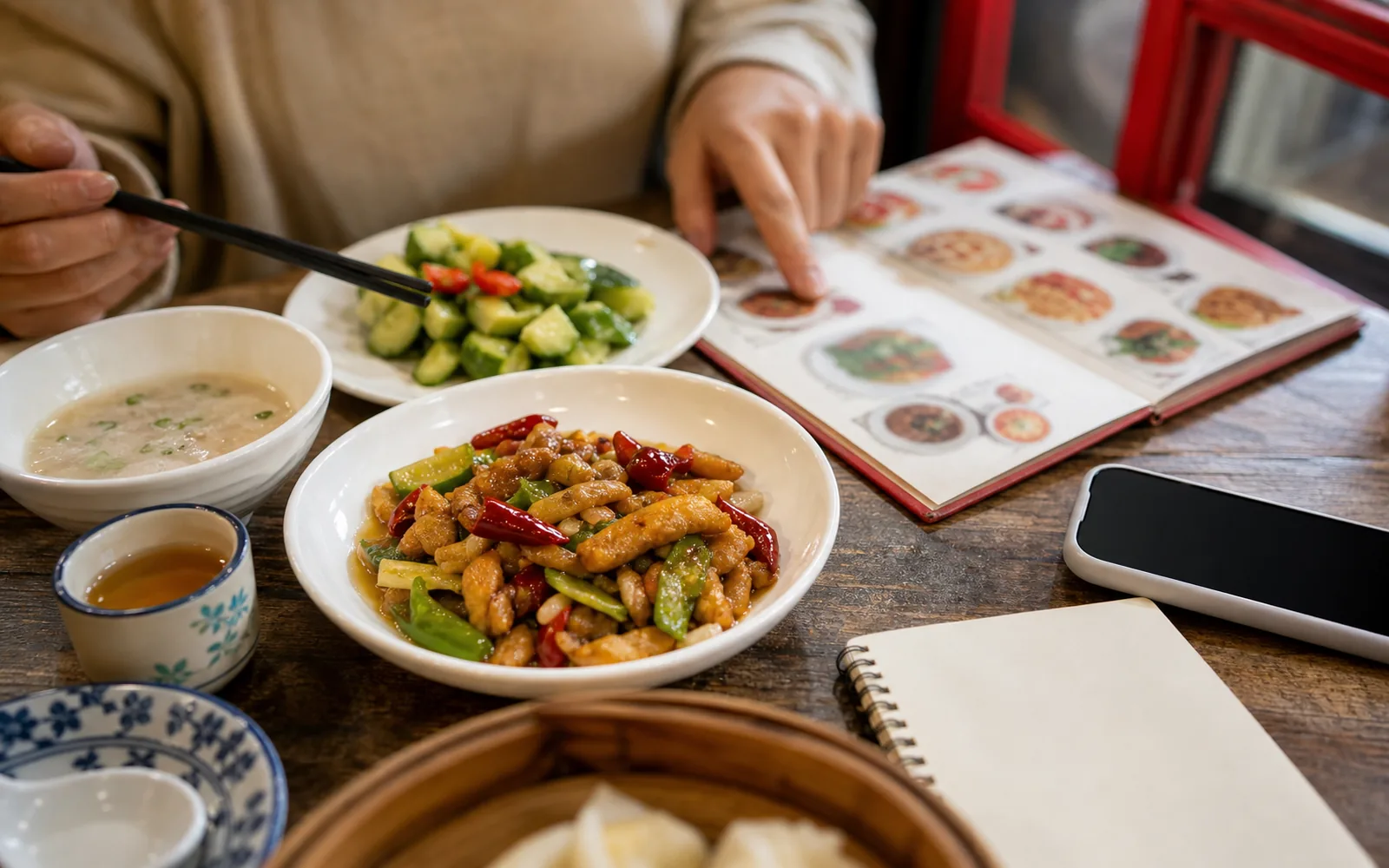



Expect QR menus in many restaurants, order dishes for the table rather than only individual plates, ask about spice and allergies early, and check the payment method before the meal becomes awkward.
Field plan
Order by reducing uncertainty before the food arrives.
Restaurants become easier when you identify how ordering works, how the table shares food, what payment path is accepted and which words must be translated exactly.
Ordering channel
Check whether the meal uses a QR menu, counter order, paper menu or staff order before everyone is hungry.
Dish risk
Translate ingredients, spice level, bones, shellfish, nuts, alcohol and portion size rather than only the dish name.
Payment moment
Ask or observe whether the table pays through a QR code, front counter, mini-program or server-held terminal.
Order a few shared dishes first, then add more. This reduces waste, spice surprises and long waits.
Choose places with photos, visible counters or busy mall food floors when language energy is low.
Restaurant ordering: what changes the decision
Before you sit down
- Know whether ordering happens by QR menu, counter, or staff.
- Prepare allergy, vegetarian or no-spice phrases if needed.
- Check payment options before the meal if your wallet is uncertain.
At the table
- Use translation for dish names, not only category labels.
- Confirm portions, spice level and shared dishes.
- Keep one backup payment route for smaller restaurants.
Food decision guide
Restaurant friction usually comes from menus, allergies, payments and peak timing, not the food itself.
Safer meal plan
- Save dietary notes in Chinese.
- Choose busy but readable restaurants.
- Keep QR payment and cash backup ready.
Risky meal plan
- Assume staff can parse complex English requests.
- Arrive at peak hour without a backup.
- Ignore allergy or ingredient translation.
 One thing to confirm
Confirm the item that would stop the day if it failed.
One thing to confirm
Confirm the item that would stop the day if it failed.
For this topic, that usually means checking the exact rule, app status, address, document or receipt before the busy part starts.
 One thing to save
Keep evidence that can be shown without mobile data.
One thing to save
Keep evidence that can be shown without mobile data.
Screenshots, Chinese names, booking records and offline notes make meal ordering, dietary limits and service expectations easier to explain.
Menu, allergy note and bill expectation
Check the dish name, dietary note, payment method, queue style and what to say if the order is wrong.
 Entry
Entry rules before booking
Entry
Entry rules before booking
 Transport
Rail and city transfers
Transport
Rail and city transfers
 Apps
Phone, maps and translation
Apps
Phone, maps and translation
QR menus are common
QR menus are common is a practical control point for this topic. Treat it as something to check early, not something to solve under pressure.
Dishes are often shared
Dishes are often shared is a practical control point for this topic. Treat it as something to check early, not something to solve under pressure.
Spice levels vary by region
Spice levels vary by region is a practical control point for this topic. Treat it as something to check early, not something to solve under pressure.
QR menus and table ordering
Many restaurants use QR codes for menus and ordering. Sometimes one person scans, orders, and pays for the whole table. In other places staff still take orders. If the QR system requires a local phone or app you cannot use, ask staff for help or a paper menu.
Shared dishes
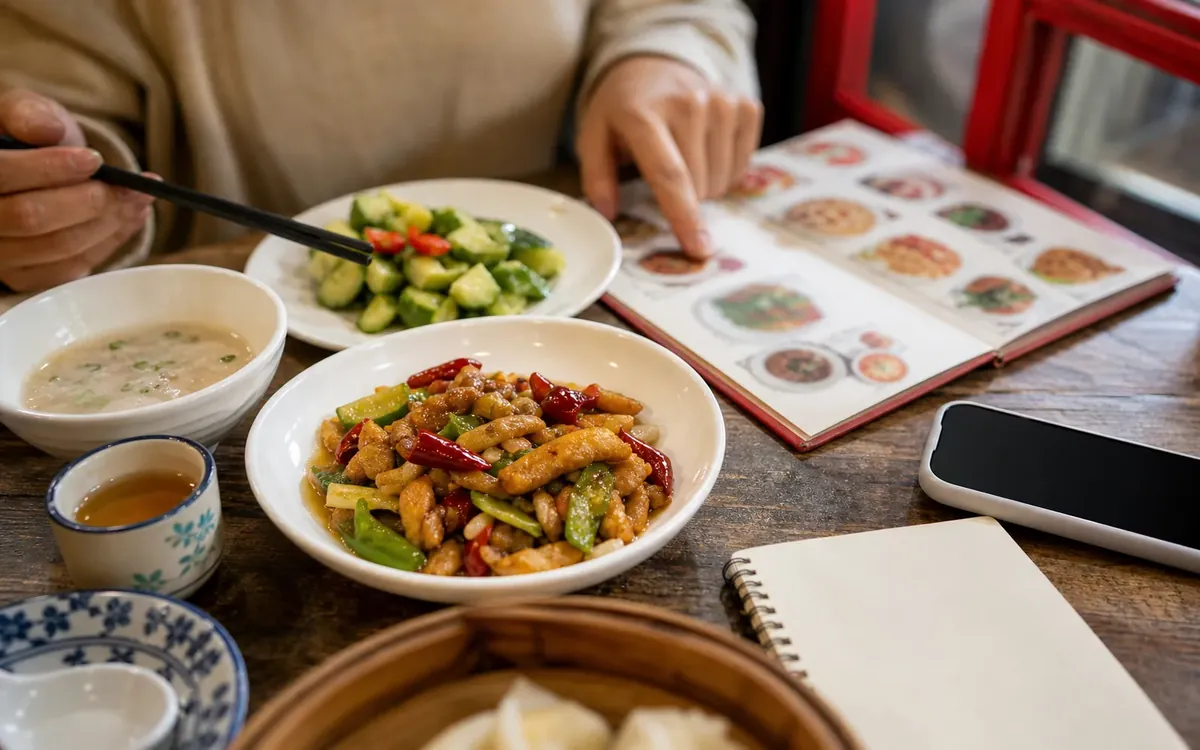
Chinese meals often involve shared dishes placed in the center of the table. One person ordering only for themselves can feel awkward in group settings. For two people, two or three dishes plus a staple is usually more practical than ordering one large dish each.
Spice and regional food
Spicy does not mean the same thing everywhere. Sichuan, Hunan, Guizhou, Chongqing, Xinjiang, Cantonese, Jiangnan, and northern food can feel completely different. Ask before ordering if you are sensitive to chili, numbing pepper, oil, or strong flavors.
Paying the bill
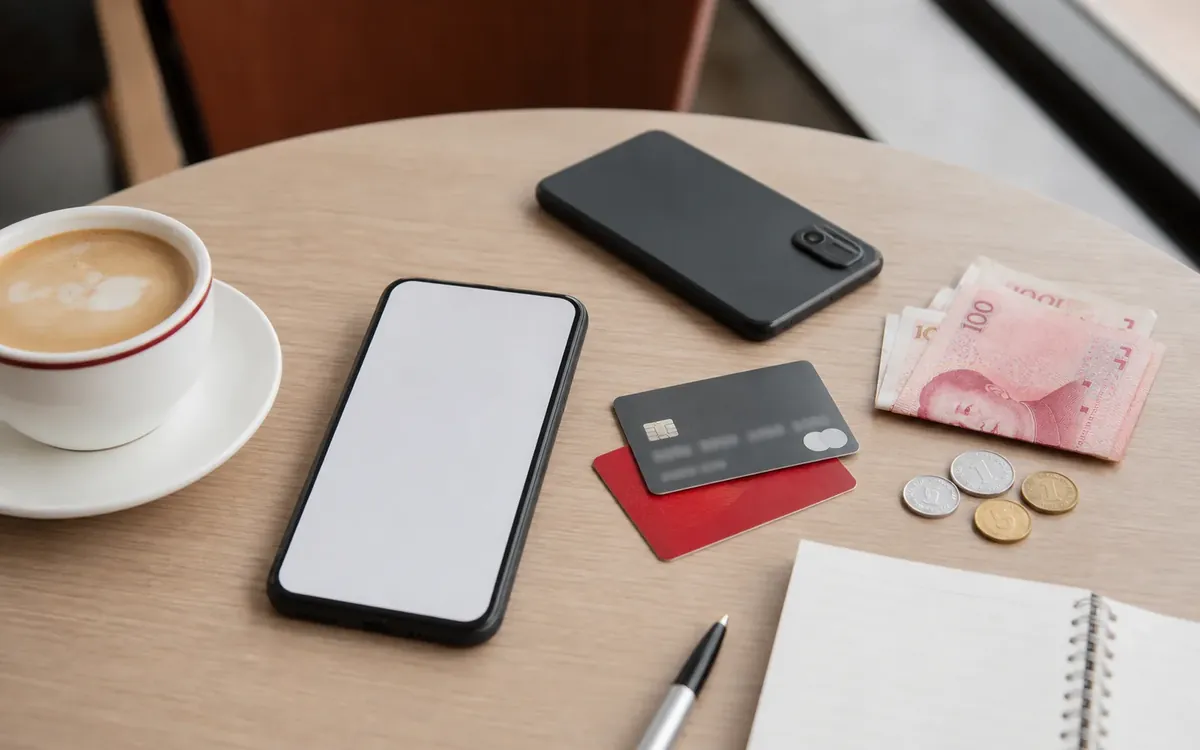
Mobile payment is common, and some restaurants expect one person to pay the whole bill. Splitting at the cashier is less common than in some countries. If you need a receipt or business invoice, ask before payment.
When the menu is impossible
Use photos, translation, staff recommendations, or simple categories: noodles, rice, dumplings, vegetables, beef, chicken, fish, soup. Pointing to popular dishes can work, but confirm ingredients if you have allergies or restrictions.
How to Order Food in China checklist
- Ask if the menu has pictures
- Confirm spice level
- Mention allergies before ordering
- Check payment method
- Keep translation ready for key ingredients
Mistakes to avoid with How to Order Food in China
- Assuming every dish is a personal portion
- Forgetting to order rice or staple food
- Discovering the QR menu requires a local account
- Ignoring chili or peanut risks
- Waiting until payment to ask for an invoice
When How to Order Food in China needs local help
Ask restaurant staff, hotel staff, a local host or delivery support when the menu, allergy note or bill is unclear. Show the Chinese phrase and avoid improvising under pressure.